Essay
A Sending
On the fate of my father’s 100 billion brain cells. And “thinking good thoughts.” And intimacy.


One early Monday morning, I’m on United Airlines flight 1348 from Los Angeles to Chicago, and I get to chatting with a cute seatmate who turns out to be a massage therapist from Honolulu. Says she’s a reiki master who’s learning something called Lomi Lomi and beginning to experiment with hot rocks. A long-haired brunette, the massage therapist compulsively reaches both hands behind her tilting head, gathers all that straight, sandy hair into a bundle, runs the strands through her fingers, fist over fist, and then lets her locks tumble over her shoulders. She does this incessantly as she speaks, even within the awkward confines of coach airline seats, so she looks at me sidewise while we speak. I have no idea what a reiki master is, but I am intrigued.
Thing is, about 20 minutes into the flight the captain’s voice comes over the speakers and says we’ll be making an emergency landing in Las Vegas. Everything is fine with the airplane, he says (his use of the word “emergency” notwithstanding), and he’ll have more information for us shortly.
The massage therapist stops speaking, tenses, leans out from her aisle seat, cranes her neck forward. I notice similarly swiveling heads in other rows, and I hear passengers wonder aloud about what could be wrong. Eventually, the captain comes on again and says the Federal Aviation Administration has ordered the crew to land – though, again, nothing is wrong with this plane or flight. We’ll be given more information once we’re on the ground.
After the usual landing bounce and skips and taxiing, our plane pulls safely up to a jetway. The captain comes on again and says passengers should disembark and then check in at the United customer service desk in the terminal. While we wait for permission to deboard, some passengers make phone calls, bemoaning the delay. Others stand and empty overhead bins. Eventually, passengers on their phones start relaying information to the people around them, in hushed but urgent tones.
This is a little after 10am Eastern Standard Time on Tuesday, September 11, 2001, so that information begins as “an accident in New York” and evolves into “an attack on the Twin Towers.”
The massage therapist and I walk our way off the plane (for the life of me, I don’t recall her name now), each say good-bye, and then I add a cautious, “Good luck.” As I enter the terminal, I see crowds gathering around television sets, staring up at the news footage. I join them and see the buildings ablaze, then falling, and join in collective gasps.
I step up to a few car rental desks, as I’m considering a long drive home to Madison, Wisconsin – or even just to the Grand Canyon to escape to the desert during what feels like an apocalyptic moment – but the rentals have been picked clean. Eventually, United Airlines shuttles us to The Suites in east Vegas, a 2-star hotel on four-lane Boulder Highway.
Once settled into my room, I wander an adjacent RV park and watch for anyone packing up, thinking maybe I can hitch a ride, but nothing materializes. Would be nice to get away from this gloom beginning to overcast every element of life here, though of course this gloom is growing throughout the country: Over the next hours, all air and train travel will stop, sporting events will postpone, the stock market will shut down, and we’ll all hold our collective breaths to see what happens next. I’ll end up spending three long days and two long nights hanging out in this cheap hotel casino.
That first afternoon at The Suites, I stand in line at the hotel restaurant while gazing in numb disbelief at ongoing live footage. Dan Rather warns me that the clip they’re about to show has potentially offensive language, and they’re still trying to verify facts, but they’ll be airing this footage anyway, and, Oohh fuck, a New Yorker shouts from the TV. On repeat, we watch the Towers crumble in a dust devil of steel, concrete, wiring, glass, ceiling tiles, carpet, PVC pipe, phone lines, computers, desks, pens, Post-it notes, and, they estimate, hundreds of fireman and police officers, maybe thousands of other people who’ve been trapped in the building and at street level nearby.
Then the massage therapist joins me in line, and we decide to eat together. We pass a placard plugging disturbingly cheap steak and eggs (apparently, most guests don’t come to The Suites in Vegas for the fine dining).
We’re seated when the therapist again begins running her fingers through her hair, fist over fist. And she talks, a lot. She recounts how she’d broken down in tears when we’d arrived in the terminal, when she saw the burning towers; she’d failed to pack her valium. Still, the massage therapist is glad she “sent” reiki to other people on our flight before it took off, “sent as unconditional love,” she says. She does this sending often with friends and loved ones and then feels good whenever she discovers that they felt better, or felt healthy or inspired, they later tell her, at the very moment she sent her offering. This makes the cute massage therapist from Honolulu feel helpful, even powerful. She figures that, under the current circumstances, her reiki sending might prove fortuitous, might help others on our flight deal with this tragedy.
I later learn that “reiki” is translated from Japanese as “universal life force” or “spiritual energy.” One reiki practitioner describes distanced sending this way: “By simply thinking of the recipient while activating the distance symbol, practitioners can send Reiki to anyone, no matter where they are.” What’s sent is a “universal life force” or “healing energy” that we all possess and swim in.
Still, the massage therapist acknowledges that her sending could only do so much about the terrorist attacks or our flight. “Things happen for a reason,” she says.
Some twenty years later, friends, neighbors, cousins, and elementary school classmates are sending me condolences on social media for a reason: I’ve just shared the news that my 80-year-old father has died of a heart attack. Among other comments on my Facebook wall:
I will keep your family in my prayers. Condolences to you all. Please accept my deepest condolences Our deepest sympathies Sending you and your family love. Holding you and your family in my heart. Thinking of you and your family Peace to you and your extended family Big hugs to you and your family. I am so so sorry for your loss. Sending you hugs. My heart is breaking for you and your family Our hearts our breaking with you!! Blessings to your family as you walk this journey. Sending warmth. Thoughts and prayers for your family. Sending lots of love to you and your family. Praying for peace and comfort! I’m so sorry for your loss and hope you are surrounded with people caring for you and yours well. Sending good vibes Holding you close in spirit and prayer. Much love to you Mark and your whole family Tons of wonderful memories to help you get through the hard days. Sending up prayers for strength, love and peace for your family! May the Lord comfort you and your family. You are in our thoughts. May memories bring you some peace during this difficult time of sorrow, so sorry May you feel God’s presence through each day ahead and know you are never alone in your grief.
Many include teary-eyed emojis, sad-faced emojis, care emojis. I also receive DMs and emails. Many of them include sentiments about sending and holding and praying and keeping. A dozen people send me greeting cards through the mail.
During the days and weeks following Dad’s death, as my family and I adjust do this new, fatherless reality, people will continue to send good vibes. Others will take the time to think good thoughts. From hundreds of miles away, a friend will text big hugs. This is February 2021, mid-Covid-19 pandemic, when few people are actually hugging one another.
As my eyes scan words and emojis on screens and notes in greeting cards, I experience no real touch or sounds or smells that would accompany more comforting, in-person human interactions. And nothing changes materially: For all that sending and praying, my father is no longer here, and he will never again be with us.
Still, these people will likely feel a touch better for having expressed their sympathies, and all of this does, in fact, provide me with momentary sensations that I associate with comfort. Something about knowing someone else sympathizes with my loss and pain actually lessens the severity of that pain, ever so slightly and momentarily, though I don’t fully know why. Apparently, a care emoji is now a form of spiritual succor.
This sending, these prayers, and even the big hugs – they don’t feel all that different than the wishes and pleas running through my head the Friday afternoon I arrive at Kettering Medical Center near Dayton, Ohio: I wish my father hadn’t had a heart attack or seizure or whatever it was last night; I hope that that short autumn hike together four months ago won’t be the last moments I’ll ever share with my Dad; I send vague appeals to a vague god – the best I know how, at this point in life, to pray, or at least formulate images and ideas that resemble prayers. As I stride down the white, plastic hallways of an intensive care unit looking for other family members, I’m basically thinking things and wanting this god, or whatever omnipotent being might be aware of my thinking and my hopes and my panic, to take an interest in me, to somehow act on this thinking that I’m doing on Dad’s behalf. But I could send these prayers to this god or send good vibes to Dad or his doctors all day, and I’m fairly certain my mind’s efforts would fail to alter the state of even one molecule of his ailing body, much less affect his overall condition or how he feels, if he feels anything at all. While I drove here from Pittsburgh, Mom told me on the phone that Dad’s brain is showing almost no activity, sending very few impulses to the rest of his body.
I pass a sign over a doorway that reads “Visitor’s Lounge,” then stop myself and circle back: that silver-haired woman in an ivory cardigan, the woman sitting very upright in one of the padded wooden chairs, is my mother. I’ve not seen Mom, who’s 78, but once in the last 14 months due to Covid restrictions. I hadn’t recognized her; we’ve all aged so much.
I enter the small room, and she stands. We hug, and she holds onto me a few extra beats. Then I hug Carl, one of my older brothers, whose Covid-beard has hit Moses proportions, extending well beyond the paper mask he’s wearing. (There are five of us boys; Carl, the middle kid, had returned home to live with Mom and Dad a few years ago. I’m fourth in line).
Though we’re mid-pandemic and pre-vaccines for most everyone but medical staff, I don’t hesitate to touch Mom and Carl. At least we’re wearing masks, I rationalize. Hospital staff are limiting patients to just one visitor at a time and asking others to remain outside of the building. Lobby gatekeepers taking peoples’ temperatures and handing out nametags are making some exceptions for “end of life” situations.
Mom fills me in on the latest. The doctors believe Dad likely suffered one of three events: a pulmonary aneurysm, cardiac arrest, or cardiogenic shock. An initial CAT scan revealed only those brainstem impulses necessary for producing the most basic body functions – pumping Dad’s heart, keeping his kidneys and liver working. A ventilator is helping him breath. His body isn’t responding to stimulus.
They gave Dad antibiotics in case infection is part of the problem. They’ve placed bags of ice up and down his body to lower his core temperature, aiming to reduce any ongoing damage to his brain. And he’s heavily sedated. Dad’s basically being held in a state of stasis, and the plan is to lessen his sedation tomorrow morning, remove the ice, let his body temperature return to normal, and see how his brain reacts.
Much earlier that Friday morning, at 2:24am when I’d been asleep back in Pittsburgh, a call from my sister-in-law, Kelly, startled me awake. Dad had had a seizure, she said. Or something. Something really bad. But he’s at the hospital now. Medics drove him there in an ambulance. And, I’m so, so, sorry Mark, she said, through tears. We’ll let you know when we know more.
Later, on subsequent phone calls throughout the morning, as I quickly packed and backed out of co-leading a writing class Zoom and then made my way to Kettering, a suburb of Dayton, I’d gather more information: at about one o’clock, Mom and Dad had just turned out the lights, climbed into bed, and said an “I love you,” when moments later Dad began convulsing. Mom yelled for Carl’s help. He called 911. Dad stopped convulsing. Then wasn’t breathing, had no pulse. Mom attempted CPR, pulled him to the carpeted floor for leverage. But it wasn’t working. So Carl tried. Mom later said it took the EMTs forty-five minutes to arrive. Then she said it was more like 10 minutes, but she really didn’t know. Their own CPR efforts did restore Dad’s heartbeat and breathing. His body and his brain again took in oxygen. When the ambulance pulled away, its sirens were off. Mom saw this as a very bad sign.
Mom again recounts all this while we sit together in the Kettering Medical Center ICU lounge. Then I leave her and Carl to round up snacks from the hospital cafeteria – yogurt and bagels and peanuts that no one ends up eating while we wait.
Eventually, we’re led by a nurse to a small, low-lit side room with steel sinks and free-standing metal storage closets, boxes of supplies stacked upon chairs, alongside overflowing garbage cans, take-out containers and crinkled soda cans, even a few pizza boxes – remnants, I assume, of relentless and harried work shifts during this overwhelming pandemic. Still, I don’t understand how this is the consultation room of choice in an ICU.
A doctor whose name I don’t catch joins us. She’s maybe 30-years-old, has long, dark curls, seems as uncertain about how to start the conversation as we do. But, speaking from behind a mask, she does: After saying she’s so sorry we’re going through all this, the doctor explains that George’s bloodwork tells us that he likely suffered a cardiac arrest. This is surprising, because Dad hasn’t had heart problems except for occasional elevated blood pressure. And, in fact, careful man that he is, Dad measures his blood pressure daily, religiously, even charts the numbers in a line graph. A couple of weeks earlier, that graph had alerted him to a slight spike, leading him to visit an emergency room where staff ordered an increase in his blood pressure medicine. Otherwise, he’s been in good health for an 80-year-old.
The doctor reiterates the plan to remove the ice bags tomorrow morning and raise his body temperature.
“And then at that point,” she says, “we can make a decision on whether or not we should make him comfortable.”
She’s been direct with us until this moment: It’s not as if he’s not currently comfortable, right? I mean, he’s getting morphine injections.
I lean forward in my seat. “When you say, ‘Make him comfortable,’ what does that mean?”
“That means we’ll stop life prolonging endeavors.”
No more antibiotics, and they’ll decrease his morphine injections. They’ll monitor and respond to any signs of agitation or anxiety, such as him pulling at or biting down on the ventilator, or else his blood pressure could spike. Then, if his brain still doesn’t show more activity, we’ll need to discuss end-of-life measures, including removing his ventilator. If we decide to provide only “comfort care,” she says, Ohio law dictates that medical staff must wait at least 48 hours once the decision is made. “We’re not military about it,” she adds, “but 48 hours later, when the family is ready, that’s when we would pull the breathing tube.”
The choice to turn off the ventilator sits with us, primarily Mom. She looks at the floor, while her wringing hands crinkle an empty water bottle. Her silver-white hair is pulled back, bunched together by a clip. Her cheeks seem puffier than I remember them being.
I ask the doctor, “If his heart’s still beating, but there’s not much brain activity, then what?”
“Let’s say we get to tomorrow, we let his body warm up, and he still looks like he does right now. I think that would be an indicator that his brain took on a lot of damage when he went down.”
She says that his pupils aren’t constricting when she shines a light on them, one sign that his brain isn’t functioning much.
“If his brain status is in fact like this tomorrow, I do not think he would be around very long after we pulled the breathing tube.”
But I’m wondering: if his body’s not responding to stimulation, and if his brain isn’t doing the voluntary work of sending impulses to other parts of his body, is he even “around” now? At this point, how would Dad’s brain even register the difference between “comfort care” and discomfort? I start to wonder if that morphine is for our sake or his.
One of the primary purposes of this meeting is to determine whether we’d like a “Do Not Resuscitate” order, a DNR. The doctor is asking us how medical staff should respond if George has another heart attack or if his body takes some other downward turn. Under a DNR, they wouldn’t attempt CPR. Last night’s efforts to revive George, she says, cracked or broke all of his ribs. With a DNR order, “If his heart stops, we’re not pounding on his chest again.” We might want to consider his quality of life if revived after a second heart attack, what he might experience as an 80-year-old with apparently severe brain damage.
Mom shakes her head. “I feel like I’d rather let him go peacefully than to let him suffer. If he’s going to suffer, let it be what happened last night, and let that be the end of it.”
Mom consents to the DNR. Carl and I each nod and say we agree that this is best.
We discuss tomorrow’s meeting, when staff will have removed the ice and raised Dad’s core temperature. Then, looking the doctor in the eyes, Mom says, “I appreciate you, and I appreciate you explaining all this to us.”
“You need to understand, so you’re making a good decision.” The doctor seems to be fighting back tears. “It’s a hard decision.”
Mom’s voice is now all stops and starts. She punctuates the end of each phrase. “If I could … make a different one … I would … but I don’t see, to me, I don’t see another, a good way to go.”
She pauses, then adds: “I almost think of it as a privilege, to have been there.”
And then her next words seem to get caught in her throat, before she says, “You know, he wasn’t alone. He was where we were always the most comfortable … I know the last thing I said to him. We always used to sort of whisper, like nobody else could hear: ‘I love you.’”
In a kind of way, my father died today, in the early morning hours of Friday, February 5, 2021.
In another kind of way, my father will die five days from now, during the early afternoon of Wednesday, February 10, 2021, when his heart and lungs and brain will stop functioning.
Later, some will say that Dad will never die. He’s simply transitioning to some unseen, celestial state. Many times this week, as we sit vigil in the ICU lounge and take turns “spending time with Dad,” Mom will say she looks forward to her “reunion” with him, when they’ll enjoy their “forever time.”
Later that evening, Carl and I are standing outside of the visitor’s lounge when a man approaches us, a priest’s collar peeking out from within his black jacket. He introduces himself as Father Grey, says he’s here to support the family, understands we’d like George to receive the anointing of the sick and last rites. Father Grey offers an outstretched hand, holds a prayer book or bible in the other. He’s maybe sixty years old, short, starting to bald.
Father Grey’s a bit too upbeat: “Well, how are we doing? Is he very responsive? Can he respond to you? He’s in pretty bad shape, huh?”
These are generic questions, of course, general enough to hit the mark in an intensive care where he’s surely working through a slew of the sick. “Pretty bad shape” stamps anyone’s ticket to this unit.
“He’d been in pretty good health?”
I peer into the lounge, tell Mom a priest is here to give Dad last rites. She’d been expecting him, but gets choked up while greeting Father Grey. Then we walk together to Dad’s room. It’s about what I would have expected: digital monitors and gauges at the head of a bed, connected to the bed and patient through a medley of wires and tubes, then a couple of chairs, a free-standing closet, and a window revealing a parking lot and trees covered in snow.
Father Grey steps to my father’s bedside, to Dad’s right. Mom takes a seat alongside Father Grey and rests her forehead upon the bedrail. She takes Dad’s hand in her own. She begins to cry. Carl stops at the foot of the bed, leans in to put his left hand on Mom’s shoulder. I walk around Carl and stand opposite them.
I would describe my father for you, but in these moments, I refuse to look at him. I only catch Dad’s peppered hair out of the corner of my eye, as I train my gaze on the foot of his bedsheets. I hold my right hand to my forehead and rub my temple, shielding my eyes from him. I look over at Mom, who still has her head down. She begins crying more audibly.
What I can tell you, more generally, is that Dad is a five-foot, ten-inch bearded man of German and Irish descent. He has a somewhat prominent, ruddy nose and, most days, a flushed complexion, with dark keratoses on his face and arms, and then that dark, peppered hair, something his mother kept until she passed away at 94. He’s a slight man, weighing just 150 pounds, and shorter than all of his sons, yet infamous for that “hollow leg” that enables him to eat all of us under the table. Mom says his weight has never varied more than five pounds since the day they married, on May 30, 1964. When I picture Dad in my mind, he is smiling.
I see enough through the hand at my temple to watch Father Grey lean toward Dad, prayer book or bible still in hand.
“George, if you can hear me now, I’m a Catholic priest,” he says somewhat loudly, somewhat slowly. “I’m Father Grey. And I’m here with your wife and your sons. And you’re in very critical condition. You may be coming to the end of your earthly journey.”
My forehead tenses. I again knead my temple with my fingers. I scan the contours of the sheet draped over Dad’s legs.
Father Gray continues: “I’m going to give you our beautiful sacrament of the anointing of the sick, pray that the Lord will give you all the gifts of the spirit that you need to help you in this difficult time, forgive you of all your sins, and if it is your time that you will go peacefully then to your heavenly home.”
Father Grey performs the sign of the cross – a gentle tap of his fingertips to his forehead, then his sternum, then each shoulder, left then right.
“George, on your behalf, I acknowledge failings, weaknesses, and sins. On your behalf, I entrust you once again to God’s gracious mercy.”
He prays that the “Father of all mercies … have mercy upon George,” says that it’s only through the death and resurrection of God’s son, through the presence of the Holy Spirit, that such mercy is even possible. He concludes his prayer, saying, “Through the ministry of the church, may God give you pardon and peace. I absolve you of all your sins, in the name of the Father, and of the Son, and of the Holy Spirit. Amen.”
Between my fingers, I can still see enough movement – and I remember enough from my childhood religion – to know that Father Gray is, with water or oil, thumbing a small cross onto my father’s lined forehead. I glance at Mom. She sniffles, holds a wadded tissue to her nose with one hand and clasps Dad’s hand with the other.
So it is that this man who’s been designated a priest, an intermediary between divinity and humanity, a man who’d never before met George Henry Kramer — this man speaks on George Henry Kramer’s behalf. He pleads with the God responsible for making George’s body and soul, an 80-year-life that had apparently become degenerate, just one of about 117 billion degenerate bodies and souls ever to walk the earth. Father Grey asks an ultimately ineffable divine being—who also apparently shaped the entire cosmos, including the Milky Way and an estimated 2,000,000,000,000 (that’d be 2 trillion) other galaxies and an estimated 10,000,000,000,000,000,000,000,000 stars (I don’t even know what -illion to call this; I simply gleaned it from the work of genius physicists, who write it as 1024) —to forgive this human for his silly sins and failings … to absolve George Henry Kramer of, say, his passing dirty thoughts or for yelling in anger at his onery kids or for missing Sunday Mass. Apparently, those sins are what we’re supposed to focus upon as the 30 trillion cells that comprise my father’s body begin failing – rather than focus on, say, the admirable ways in which Dad lived out his commitments to marriage and parenting and even his Catholic faith, or else the integrity and dedication he brought to any task, or the lessons in honesty and generosity and fairness that he passed on to his children and grandchildren, like the afternoon he sat down 10-year-old me on the edge of his bed, and we talked about how if someone were to ever hit me, sure, I had the right to defend myself, but you’re not supposed to just hit someone, even if they start it: it’s up to you to take the high road, he said, be bigger than them – defend yourself, but treat others well no matter how they decide to handle themselves. Father Grey makes no mention of George’s love for God’s creation, the ways in which Dad instilled in his kids an appreciation for nature through so many camping and hiking trips, so many muggy, mid-afternoon treks in the woods when he’d delight in seeing old growth hardwoods, when he’d stop in his tracks, crane his head upward, and just stare in apparent awe and wonder (and, I fully believe, gratitude to this creator God) at the breadth and scale of those oak, ash, elm, and poplar trees causing him to shake his head and click his tongue against the roof of his mouth, exclaim Would you look at that!, and then nudge one of his sons into posing by a tree’s base, providing perspective for the requisite photograph. Father Grey’s prayer doesn’t have the capacity to describe George’s drive to make things with his own hands, in the same spirit as this God’s handiwork, an impulse that led Dad to a career in electrical engineering. Instead, Father Grey asks God to exercise beneficent mercy when judging what came of this creature that God himself had made. Dad’s immoral acts are, apparently, what’s weighing on this creator God’s mind during the liminal moments when some immaterial part of my father is about to pass into heavenly ether. At least we hope that’s where Dad is headed, if God judges his own creation worthy of “living” in eternity alongside Himself (or Herself, or Itself … or whatever…).
Ultimately, I don’t blame Father Grey for lacking a prayer that encompasses who Dad is, or any supplication that could account for the depth and richness of any single human life. Father Grey is himself human, with the limited capacity of a human, acting on behalf of a very human institution. And every single life is so complex and layered and wondrous. Really, the hospital is doing what it can, providing this spiritual support, acknowledging that patients and their loved ones have existential needs.
This includes my mother, who seems glad that Father Grey is here and gave consent to the ritual. But Father Grey doesn’t need Dad’s consent to say these prayers, to anoint his forehead. Father Grey doesn’t need a response from Dad to make these sacraments count. They’re a grace, a gift. But if Mom had put the brakes on Father Grey’s intercessions – say, on some apostatic whim, because she’d begun to feel a certain way toward God as she let go of her lifelong companion – would she have altered the fate of my father’s soul?
Like the morphine, I wonder if the anointing and last rites are more for us than for Dad. It seems he can no longer deduce ideas or compute sensations. Given what doctors have told us, Dad likely can’t feel or taste or smell. He almost certainly doesn’t glean anything from the voice of the priest standing over him, who’s directing his words to the most celestial being any of us can even imagine – which is, admittedly, no small brain computation.
In fact, as far as I can tell, Dad will never again hear words or comprehend them. He’ll never again talk, read, or sing, much less pray. He’ll never again chew or walk or sneeze or shower. He won’t chart or dig or engineer. He’ll never again saw, hammer, or plane, draw, watch, play, rewind, hold, caress, or copulate. He’s done dwelling on ideas, swinging golf clubs, and mowing the lawn. He can no longer send thoughts or good vibes, much less receive them. I want to remain open to the possibility that this other human, Father Grey, who’s dedicated his life to developing some semblance of understanding of the divine, might actually be able to pray or send good thoughts on Dad’s behalf. But if Father Grey had contracted Covid and called off sick this morning, if no other priest had been available, would that slight change in circumstance have prevented Dad from receiving these sacraments, and, in turn, made a difference in his heavenly fate?
Tomorrow, when I’ll return to my childhood home and we’re all milling about in a fog, eating, drinking, and wondering what comes next for Dad and his flickering brainwaves, I’ll find on his laptop the autobiography he’d been working on for years now. According to the book’s preface, George Henry Kramer wrote out his 60,000-word story because, “my sons grew up not really knowing much about what I did as an engineer.” Dad had dragged his feet about sharing the book with me because, in his usual way, he wanted it to be absolutely perfect first, down to the page formatting and clean footnotes.
I’ll end up scrolling through the book, page by page, enjoying Dad’s childhood reflections about growing up on Livingston Avenue in Dayton, visiting so many relatives, playing records on the family Victrola, 78 rpm. And then one particular summer day when he captured an albino squirrel, which got him and his brother in trouble with the local magistrate. I’ll skim passages that include various calculations and engineering concepts, which he apparently thought his sons also needed to know:

Just days earlier, Dad could have lectured me ad nauseum on this material that my mind – at least in its current state – would not comprehend. Suddenly, his own brain is no longer able read, decipher, calculate, or write any of this material:

Tomorrow, I’ll think more on all this – the calculations and concepts, the brainwaves and wavelengths, the galaxies – while I’m poring through his autobiography and grazing through food in the refrigerator that Dad last touched.
For now, though, I’m still watching Father Grey between the fingers rubbing my temple. He continues: “Through the holy mysteries of our redemption, may almighty God relieve you of all punishments, in this life and in the life to come. May he open to you the gates of paradise, welcome you to everlasting joy. George, through this holy anointing, may the Lord in his love and mercy help you with the grace of the Holy Spirit.”
Mom holds Dad’s hand against her cheek, as Father Grey concludes: “May the Lord, who frees you from sin, save you and raise you up. Amen.”
I recall then that just recently, in a moment of parenting frustration, I’d been mulling on the limited value of punishment as a response to rule breaking or obstinance. What if every other word to my two teenage kids was a recitation of their “failings, weaknesses, and sins”?
Father Grey prays for George’s health and “that at this critical time he will know your loving presence, that he will be at peace and be unafraid.” Father Grey also prays for blessings upon George’s family and the hospital staff and, “for those intentions and all that George has in his heart this evening.”
Then, together, we pray an Our Father and a Hail Mary. After a few lingering moments, Mom stands. She and Father Grey exchange a fumbled hug. We all turn to leave.
Father Grey looks to Carl and me: “And we’ll pray that he goes peacefully, huh? If that’s the Lord’s will.”
As Carl and I follow Mom and Father Grey out of the room, we pass the television hanging on the wall at the foot of Dad’s bed. It had been on this whole time, though at a low volume.
Carl says to me, a bit more chipper than usual, “They could have at least put Fox News on for him.”
I respond, with a shake of my head and a stage whisper: “They’re trying to make him better, Carl.”
Over the course of five days, we wait and see.
Later that first evening, my brother Mike – second in line among the five sons – joins us at the hospital. Unsure how we should handle the risks of Covid exposure and spread, he and I crash at a nearby hotel rather than stay at the house with Mom and Carl. As the week progresses, we’ll all decide we’re in this pandemic mess together now, so we’ll hug and cry and live with one another, wearing masks inconsistently.
On Saturday, the next morning, our oldest brother, Chris, and his wife, Cindy, arrive from New Jersey, having driven through the night. They’ll probably just be here for a day, Chris says. A chance to say good-bey to Dad, the way he sees it. We camp out in a small, sparse lobby by the parking garage elevators, hoping no one asks us to disperse; hospital staff are now enforcing the rule that we’re supposed to have just one visitor in the building. Over the next few days, our access to the ICU and its visitor’s lounge depends upon which staff are on duty and just how near to death Dad seems to be. We take turns going upstairs to see Dad, but I choose not to. Mike and Mom meet with medical staff. They say they’ve raised Dad’s body temperature. His condition remains the same, but no major decisions are made.
Later that Saturday afternoon, we go to Mom and Dad’s house, the home they built south of Xenia, Ohio, in 1979, where they raised their family. From the small bedroom where I spent my middle school years, I call my ex-wife and two teenage kids and fill them in on how Grandpa is doing. Then I shuffle through snow in the woods, amidst cold sunshine, through a stand of walnut trees where I used to play baseball with my brothers. Jamming my gloved fists deep into my coat pockets, I find myself near tears and scanning these woods for I don’t know what. I’m saying aloud: “He gave this to me. He gave this to me …”

On Sunday, we return to the hospital, later in the day this time. We expect little to have changed. Kevin, the youngest son, arrives from Los Angeles. He’d driven across the country to avoid Ohio quarantining regulations that an airline flight would have triggered. We’d waited for him to get here before making end-of-life decisions, though we’ve begun discussing funeral arrangements: Dad’s brainwaves aren’t any more evident now than they were on Friday. We’ll return again tomorrow morning, when they plan to run one more CAT scan, just to be sure. I still don’t go in to see Dad.
I spend much of Sunday evening rejigging plans for writing courses that I teach, moving some sessions to asynchronous work, cancelling other class periods altogether. Covid has inspired somewhat more manageable methods for such rejigging … and dealing with this loss that has, to my mind, also resulted from Covid.
On Monday, we have a long conversation with another doctor. We decide what’s already been decided: It’s time to let Dad go. Staff submit the “comfort care” order. That 48-hour clock begins ticking. They’ll remove the ventilator on Wednesday.
I decide to finally spend time alone with Dad’s body and his minimally working brain. But just as I open the door to his room, I get a call from another man named George, an advance planning counselor with Tobias Funeral Home, which Mom had chosen for services. After condolences and niceties, he works his way to asking for more information about George – Was he military? Where did he grow up, Where did he go to school, Who will survive him? We briefly discuss likely arrangements. At the foot of Dad’s bed, and having not looked at him yet, I pace and begin to fidget, then eventually just leave the room to wander and finish my call outside, walking the hospital grounds in the bitter cold. The call and my brief, distracted time in Dad’s ICU room feel about as mundane as scheduling an appointment with my car mechanic.
On Tuesday, before heading to the hospital, Mom, Carl, and I visit Tobias Funeral Home to plan what will be a private burial and then a second, live-streamed memorial service. Dad will have a “natural” burial at Calvary Catholic Cemetery in south Dayton, in a wildflower field next to a pond, something he and Mom had decided upon a few years ago. The funeral home won’t use the usual embalming chemicals, and we’ll only bury him with biodegradable materials. Even plastic buttons on his clothes, the advance planning counselor says, aren’t allowed.
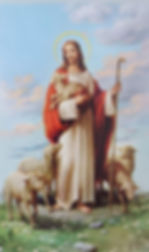
We choose a plain, unvarnished pine casket. Mom picks out a prayer card with a wispy painted Jesus holding a lamb while other sheep bleat at his feet. The back reads:
I am the good shepherd;
I know my sheep and my sheep know me –
just as the Father knows me and I know the Father –
and I lay down my life for the sheep.”
John 10:14-15
We’re grateful for Dad,
who was our shepherd.
On Wednesday, I wake to this thought: My father will likely pass away today. Also: My father died last Friday.
Staff at Kettering Medical Center took a final look at my father’s brain two days ago, with a CAT scan, and determined that it was showing no more activity than it had been when they first examined it, after all that early morning violence and oxygen deprivation.
So, at our direction – Mom’s in particular – staff had stopped feeding Dad’s body intravenous nourishment. They eased up on his sedation and antibiotics. They did continue monitoring his pumping heart, however, work that his brainstem and body were performing on their own volition. His kidneys and liver were also still processing fluids, filtering out impurities. In fact, in a way, Dad’s body has been chugging along just fine – so well that we could, with the right fluids and nutrients, keep it functioning like this for quite a while, if we chose to. We could sustain his body’s 30 trillion cells, minus those critical but now expired neurological cells responsible for his now defunct central command.
But his lungs, they need direction that his brain is unable to provide, so he’s remained on a ventilator. Until today, that is. And once this machine stops helping his body route oxygen to those trillions of cells, those cells will suffer annihilation. His body will shut down. We’ve been told that, once the ventilator is removed, Dad’s body could go in a matter of moments, or it could continue functioning for several hours, maybe a day or two even, but that’s about it. That’s when we’ll say that Dad is dead.
We’ve made this choice to remove the ventilator believing that his body’s condition – well, specifically his brain’s condition – will never, ever improve, and as a result we’ll never again encounter the man George Henry Kramer, through that body. And if his current, hobbled state is an indication that we’re never again coming face to face with the person George Henry Kramer, I can only conclude that we did in fact lose him last Friday when his body first entered this state.
For the human brain to survive and function, its 400 miles of vessels and capillaries must constantly feed it oxygen. The brain itself directs other organs to do this self-serving work. Otherwise, within a matter of just a few oxygen-less minutes, those billions of fragile cells are done for. Up until about one o’clock last Friday morning, oxygen coursing through Dad’s body not only enlivened his neurological cells and kept them firing, but it also helped his brain remain malleable. These days, it seems everyone – from self-help gurus to social psychologists, from journalists to documentary film makers – is noting the powerful ways in which the brain can reroute its own synaptic patterns. The brain, researchers tell us, adapts to experiences and changes by reorganizing neural pathways and creating new connections, especially when actions or thoughts are repeated. The brain’s physical structure actually changes, a quality that scientists call brain plasticity.
This rewiring has incredible implications for how we approach everything from practicing a sport or musical instrument, to dealing with addiction or memory loss. Change a behavior, learn a new pattern, and your brain transforms, thereby reinforcing that new behavior. Act differently, habitually enough, and we literally become different people. Yet more proof that these fragile, three-pound machines inside our skulls, comprised mostly of water, these organs firing some 10 quadrillion (that’d be 10,000,000,000,000,000) synapse operations every second, with waves travelling at 120 miles per second, are dynamic and alive and unbounding in possibilities. This goes for every healthy, 100 billion-cell brain in every human head.
That said, at some point each human brain becomes much less malleable. Every brain, and every life, will eventually dissolve. After developing in utero and continually plasticizing for more than eight decades, Dad’s brain and life are suddenly wrecked. Simply because he lacked oxygen. On just one occasion. For just a few minutes.
If you’d asked me one week earlier, when Dad’s brain cells had been firing away as usual (though maybe less efficiently than during his younger years), if he was there, I would, of course, have answered in the affirmative. Obviously, Dad was there. Just look at him, I would have said – there in his home, there eating breakfast, there sweeping the kitchen floor, there muddling through another dreary pandemic day. Also, he was there as a being with personhood – maybe even somehow, mysteriously, there as a soul transcending the biology of chemical reactions across synapses.
But five days after most of that grey matter had stopped functioning, leaving only the most reptilian, brainstem portions of his brain to do their work – heart pumping, blood cleansing, bile making – I’m not sure that person, George Henry Kramer, is there anymore. Or if he’s been there at all during this entire ICU vigil. For all I know, his being or soul might have already transitioned to some “better place,” or might now transition once those electrical impulses stop. Or he might never transition. He may no longer exist.
That Wednesday morning, around ten o’clock, we meet at the Kettering Medical Center ICU lounge – Mom, four of us sons, and Kelly, my brother Mike’s wife. Most everyone takes a turn visiting with Dad one-on-one, though I don’t.
While Mom is in with him, she texts us letting us know that “it’s ok” if someone wants to join her in the room – which we, of course, read to mean she wants someone to join her.
So, I go. Though I’ve been in the hospital several hours each of the last five days, this is only the third time I’ve entered Dad’s room. I again try not to look at him, and instead move directly to Mom, who is sitting by his bed, leaning on the guardrail. She’s wearing a lavender sweatshirt; I catch a glimpse of bedazzled snowmen on the front. She turns to me. Her eyelids are swollen.
“Mark, would you help me get into bed with him?” She’s cleared it with the nurse, she says, and staff are willing to help.
I find Madison, our cheery, young supervising nurse, and she and another staffer come into the room. From Dad’s left side, they pull on the bedsheet underneath him, forcibly so that his body shifts to one side of the mattress. Wires and the ventilator tube jostle. I help Mom lower the guardrail on the other side of the bed, and she sidesaddles onto the mattress. As I reach to help Mom swing her legs onto the bed, my hand grazes Dad’s forearm. Then, with a few quick thrusts, Mom slides her body close to his. I click the guardrail back into place.
“This is where we were most comfortable,” she says.
On several occasions this week, Mom’s alluded to just how much she and Dad enjoyed their time in bed together. She’s followed each comment with something along the lines of, “Well, how do you think you got here?” It’s not as if sex was a topic of conversation with us kids for most of our lives; I think she just enjoys watching us squirm and roll our eyes. In fact, while driving into Dayton the other day, she’d shared, for some god-awful reason, that, “He was going strong all the way up to the end … You laugh, but not every man can do that. It was a gift.” I swear to you, those were the words that my 78-year-old mother said. Aloud. To her adult child. Intentionally.
Now lying next to Dad, Mom sets her hand and lavender-sleeved arm atop his hirsute forearm, just below his IV catheter. She leans her head into his shoulder and closes her eyes. This becomes the first good look I’ve had of my nearly braindead father in his ICU bed.
Dad’s dark, fine hair is usually well-combed, particular and parted. Now it’s tousled and oily. It’s also long because he hasn’t cut it much during the pandemic, so it flames upward, exposing his forehead and the contours of his skull. This rumpled look may also be an effect of his head’s backward tilt, on account of the arched ventilator tubes taped to his face – one small tube snaked into his nose, another larger one strapped to his mouth.
Dad’s head tilt reminds me of the many, many nights he’d fall asleep in front of the television. His eyes would droop and his head nod backwards – so, so slowly. Then the room would fill with a choked snore – subtle, initially, but then it’d warm up to such a decibel that no one could hear the television. One of us would curtly call out, “Dad …,” startling him awake. We’d repeat the process every few minutes: nod, snore, “Dad ….” Some nights, as his eyes closed and his body relaxed, his head thumped into the hollow wall behind him. Jolted into a bewildered, awakened state, he’d perk up and watch more television, but eventually nod off again. We’d snicker, but also feel exasperation: “Dad. You’re falling asleep. Again … Dad ….” But here in the ICU, I hear just the muted wheeze of Dad’s ventilator-assisted breathing.
I scan the rest of him. His beard is whiter than when I last saw him. Moles, keratoses, and freckles on his face, neck, and arms remind me that he’d had several small, benign tumors removed from his temples and cheeks over the years. Prominent blood vessels branch over the surface of those temples, as well as his forearms. These arms have various wires running from them to various machines. Though bedsheets prevent me from seeing much of Dad’s body, he seems smaller than I remember.
I watch Mom and Dad cuddle – the very last time, after 58 years, that these lovers will mingle their bodies, their warmth. The last time that at least one of them will sense the other’s touch. Mom lifts Dad’s left hand, which has swelled as fluids have gathered in his inert body, and places it on her forearm. Then she balls her own hands together. He is now holding her.
With her eyes shut, Mom weeps. Then she whimpers, “I love you so much. I don’t want to let you go. I don’t want you to go.”
After a few more intermittent whispers and then silence, Mom tells me, with her eyes still closed, that I can take pictures, “… if you want to.” I pull my phone from my back pocket.
I resent that Mom has made me part of this moment – watching her crawl into bed with Dad’s body and then compelling me to document this agony in detail. I really just want to leave the room. Still, I know there’s something in this, for her, that’s comforting and right. Mom is desperate to hang onto the deepest, most tender intimacy she’s ever known. My irritation passes, and I snap a couple dozen pictures.
No kid wants to see his parents in bed together, under most any circumstances. I do recall enjoying Christmas mornings when my brothers and I would stir Mom and Dad before sunrise by jumping into bed with them. Or else bringing them breakfast in bed. But I also recall a much less savory instance, one late night when I was about 10 years old, when I apparently sleepwalked into their bedroom. I have vague memories of standing alongside mounded, rustling sheets and blankets, hearing their voices, and then a sudden stoppage of movement and sound. After that my mom’s voice: “Mark, is everything okay? What do you need?”
I responded, “I have your clothes. I’m delivering your clean clothes to you.”
After folding the laundry each week, Mom would often assign one of us boys to “deliver the clean clothes,” no small undertaking in our large household, and here I was dutifully doing my job. In this moment, though, I was, of course, empty-handed. In a steadied voice, my unseen mother suggested I head back to bed.
The next morning, in the kitchen, Mom asked me if I remembered anything “different” from the night before. Only then did it dawn on me what’d I’d heard and seen.
“No. Nothing. Why?”
“Oh, nothing. Nevermind.”
Here in Dad’s ICU bed, Mom is resting her head on Dad’s shoulder. She pipes up, saying, “I’m at peace here,” before going quiet for several more minutes. Possibly she’s fallen asleep.
Then, without opening her eyes or stirring, she continues speaking to Dad as before: “I don’t want you to leave. I don’t want to lose you … I love you … Don’t leave me.” I feel my throat constrict.
Earlier in the week, while in the ICU lounge waiting for this last day of “comfort care” to come, I’d been poking around on Dad’s laptop and paging through that book he’d written. About marriage, he said this:
When I think about the woman I married, I have this image of a vast, open, inviting, loving, deeply emotional, inquisitive, and quick-witted person. I believe Elaine’s eyes are what first drew me to her. I felt, when I looked into her eyes, that I was somehow being embraced. I felt as though I was looking into her soul, and was, at that moment, united with her. I found that that is where I wanted to be – to always be united with her. That unity with the person I love is still the most dominant driving force in my life today. In a way, this drive for unity with Elaine can be somewhat frustrating, because I know I can never achieve it completely, even though it is what I seek with all my heart and soul. There is so much goodness in Elaine that she embodies the God that I grew up seeking to be united with. Because… [Revised on 12/10/13].
Though I never had a chance to talk about this passage with Dad, I think I know how he would have elaborated upon this pursuit of “unity with Elaine.” I know this because we’d talked about marital love on several occasions: For him, loving Mom was a matter of setting aside his own wants and wishes and instead tending to her needs, first and foremost. He said he was happiest when “giving myself” wholly to her, whether through work around the house, supporting her emotionally, or, he said, sexually. He emphasized that marriage took work, a commitment to his wedding vows. Love was a choice.
Mom and Dad certainly didn’t have a perfect marriage. No one does. Even in recent years, we kids would shake our heads at the squabbles and strained communication that we’d seen for years. Dad didn’t encounter the depth of intimacy that he could imagine experiencing. This, he wrote in his book, led to feelings of frustration.
But they had desire and devotion in spades. I recall Mom and Dad often holding one another in the kitchen, kissing while dinner steamed on the stove. I could show you thousands of photographs memorializing family moments – vacations and holidays, birthdays and graduations, picnics in parks. In many of them, Mom and Dad are clinging to one another, nuzzling. Now I’ll also have images of them nestled together in an ICU bed, on the final day of Dad’s life.
The “embrace” Dad felt when looking into Mom’s eyes, this glimpse into her soul, and even his “drive for unity” – these have now run their course.
Early that afternoon we reconvene in the ICU lounge, which we have to ourselves. Mom asks each of us, addressing us by name, if we’ve had enough time with Dad. Everyone has. Without further deliberation, Mike leaves to tell medical staff that we’re ready to remove the ventilator. Ten minutes after he returns, a nurse comes to the lounge, says they’ve finished and that we can go in, all together this time.
I trail Mom and Carl into Dad’s room, step to his right side, between his bed and the door. I catch a brief glimpse of him. His eyes are closed. His body is still. And the room’s silence catches me off guard. I realize just how much noise the ventilator and monitors had been making. Kevin walks to the far side of Dad’s bed. Madison steps around him and hits a few buttons on a monitor. Then she leaves.
I train my eyes in Kevin’s direction. He doesn’t look my way at first, but then he does, and I feel myself give an involuntary nod, and I think I perceive him nodding back, with a grimace.
Then Mike and Kelly come into the room. I turn to Mike and whisper, “He’s passed.”
Mike responded almost reflexively, bending over and putting his hands to his knees, choking out an “Oh, god.” Kelly put a hand on Mike’s back, then stepped toward me, gave me a hard hug. I began crying, from the center of my chest, intensely and quietly, but only for a few suffocating moments.
Then, each of us just stood or sat in silence, except for a few snivels. We stared at Dad’s body, looking to one another, then again at Dad. After several minutes, I heard the door’s nob turn and click and then the clattering of window blinds. I turned to see the hospital chaplain, a mousy, apologetic, middle-aged woman whom we’d met a couple of days earlier for just a few brief moments. Slowly, she stepped into the room.
I leaned toward the chaplain and told her my father had just passed away. She hesitated at first, then said a few mumbled words about how she was so sorry for us, asked if there was anything in particular we wanted her to read or pray. I suggested the Beatitudes from the Sermon on the Mount, a passage Mom had been mentioning all week as we prepared for Dad’s burial. The chaplain paged through her prayer book, said she wasn’t sure she had that with her. I pulled my phone from my back pocket, searched, and found the passage – chapter 5 in the book of Matthew. I told the chaplain I could read it.
“Blessed are the poor in spirit,” I began, more steadily than I thought I would, “for theirs is the kingdom of heaven. Blessed are those who mourn …” Here I paused a few beats, felt myself choke up, then: “… for they will be comforted.”
I read on about how blessed are the merciful and the peacemakers, the clean of heart, those who hunger and thirst for righteousness. Then I lowered my phone, turned to the chaplain. She read a short passage from her prayer book, again said that she was sorry for our less. Then she left, quietly.
With help from me and Carl, Mom again climbed into bed with Dad. Positioning herself alongside his body, closing her eyes, and balling her hands together, Mom whispered that she didn’t want him to go, didn’t want to let him go, loved him, didn’t want to lose him, loved him …
I looked at what was now Dad’s corpse: his head was still tilted back and his mouth, now clear of the ventilator, remained open and his eyes remained closed. Already his body was turning a jaundiced yellow as blood had stopped flowing. I wondered where all his blood had gone. Sure, his heart had stopped pumping, but his body still contained those five liters of fluid.
Eventually, Madison stepped into the room again and said a doctor would need to come in and confirm George’s death. I don’t know when I felt prompted to go, how I’d decided I’d had enough time “with” Dad, why exactly I chose a certain final moment. I don’t remember leaving Dad’s room.
According to Dad’s death certificate, and according to Dr. Fuad Hajjar, the pulmonary doctor who signed that certificate, Dad died on Wednesday, February 10, 2021. The “manner of death” is listed as “natural.” The certificate doesn’t list a specific time of death.

What I haven’t told you about the cute, brunette massage therapist from Honolulu, who I met twenty years before that wintry February day that my father passed away, is that at one point during our conversation over cheap steak and eggs she went into great detail about how she enjoyed kneading skin and muscles, feeling warmth flow from her fingertips, trying new massage techniques. She used oil and rocks and knuckles, she told me. She eased limbs and temples and torsos with her fingers, then her entire hands. She talked and talked and talked about all this for quite a while, as if in these very moments she was kneading her words into my mind, my flesh. She just liked the human body, she said, which made me curious about hers, and mine.
Then the cute, brunette massage therapist said she’d been working on new Lomi Lomi techniques, and, “Would you like to come up to my room and try them out for yourself, with hot rocks? I’m always looking for someone to try new techniques on. And, well, we do have some time to kill.”
I didn’t skip a beat: “Thanks, but no. I have freelance work to finish. And, besides, with all this going on, I just want to take some time, get my head straight.”
What I didn’t tell the cute, brunette massage therapist was that my girlfriend back in Madison likely wouldn’t want her beaux hanging out in a cheap hotel room with a beautiful masseuse who’d be gladly and giddily rubbing hot oil all over his body. My girlfriend and I had spoken by phone, briefly, and things were strained, as they often were. Mostly we just wondered aloud about how surreal this whole Twin Towers ordeal was and talked about how or when I might get back to Madison. While I felt some loneliness, stranded as I was 1,700 miles from home, and was coping with the aftershocks of a terrorist attack, I doubt my girlfriend would think these adequate reasons for such a tryst, no matter how much I might argue that helping this nice young woman practice the finer points of her profession was practical use of so much down time.
We finished our steak and eggs and parted ways. The next day, I saw her again, in passing in the hotel restaurant, and we simply waved. I never saw the cute, brunette massage therapist again.
Had I gone back to her room and received those kneading fingers, tried out that Lomi Lomi, I’d now have much different memories and emotions and stories associated with those three days in Vegas. My brain synapses would now be making very different connections when accessing memory files that reount that experience (and possibly finding these files in different parts of my brain). I can imagine us having had a pleasurable time together, maybe sharing a momentary connection. And while I tried mightily to hear her invitation as only a simple and sincere offer to give me a professional rubdown, it’s possible that Lomi Lomi could have led us to much more, and maybe from there – because even more outlandish circumstances have brought people together – even love, and maybe even a future together, a lifetime of her sending me good thoughts, and maybe even a “forever time.” But I doubt it. Instead, my discretion resulted in us parting ways and, for me, glum meandering around a quiet Las Vegas that wasn’t its usual, frisky self. I spent mundane hours just waiting and walking sparse city sidewalks, afternoons by the pool, alone, burning in the sun, reading and dabbling in that freelance work. I didn’t even gamble, though casinos were open.
Now, don’t get me wrong. Turning down the massage therapist’s offer of Lomi Lomi wasn’t terribly difficult. As attractive as I found her, as much as I craved companionship and touch amidst that week’s gloom, my moral compass just didn’t go in on casual encounters. More to the point, I was strongly motivated by loyalty to my then-girlfriend.
In fact, it turned out that my discretion helped keep me and my then-girlfriend on a path to marriage and, eventually, two children. Instead of Lomi Lomi, I was, in a sense, ultimately choosing a deeper intimacy with someone who just didn’t happen to be sitting across the table from me at that lonely, inopportune moment. I didn’t want intimacy with someone who just happened to be an attractive massage therapist from Honolulu. I wanted connection with someone I loved, someone with whom I’d already shared a few years’ worth of memories, with whom I was considering a future, testing the waters and talking about marriage in the ilk of our parents’ relationships: lifetime vows of best-of-times, worst-of-times self-sacrificial love. I wanted Mom and Dad’s brand of devotion, which, it seemed, would prove much more fulfilling than some stranger’s seductive Lomi Lomi session.
What I also haven’t told you, though, is that my then-girlfriend-turned-fiancée-turned-wife-and-mother-of-my-children and I would, after 18 years of marriage, end up divorced. In fact, our divorce decree was filed with the Court of Common Pleas of Allegheny County, in the state of Pennsylvania, just one day before Dad’s heart attack. I never did, in Dad’s words, achieve “unity with the person I love.”
But neither did Dad. While it seems he came markedly closer than I ever have to this experience of unity, he wrote in his book that he still felt frustration over a desire for connection with Mom that would never, ever come to full fruition – even as he sought it “with all my heart and soul.” Dad even likened this endless striving with his pursuit of God. I know Mom felt the limits of their relationship, too.
Now, after decades of fusing their lives together, Mom and Dad’s marriage is over. Dad is gone. Mom is heartbroken. At times, she’s seemingly inconsolable. Even a great marriage – arguably one of the most intimate of intimacies – is, with each day, barreling toward this eventual end.
Still, maybe Mom’s “forever time” with George Henry Kramer will resolve this disunity. I can understand her believing a “forever time” remains on her horizon. It makes sense to me that someone would believe – or, at least, want to believe – that as two become one through marriage, as that shared intimacy grows so deep, that your love can somehow transcend death.
But what would this mean for my own failed attempt to intertwine my life with someone else’s life? If my marriage has truly dissolved, at what point exactly were we no longer going to experience our “forever time”?
Did our “forever time” end on October 18, 2019, during a cool Friday afternoon when my then-wife and I argued in a desolate, cemented courtyard, when I told her that I was sorry for my part in our failed marriage, but that I was done with all the fighting and distrust and heartache, and that I felt divorce was, finally, our best and maybe only option?
Or did our “forever time” end the next year, on August 15, 2020, when I wrested my wedding band from my left ring finger? I’d just filed form 3a online in the Court of Common Pleas of Allegheny County, Pennsylvania, Family Division, for case number FD-20-008554, Kramer v. Kramer, in order to initiate a Divorce Complaint. Did my click of the “submit” button, thereby uploading form 3a into a digital cloud, end our shared transcendent path? Would I have maintained our joint celestial fate if, minutes later, I’d reversed course, not handed over credit card information and ponied up the $198 filing fee, and instead deleted my 3a form?
Or did we dissolve our eternal melding a few days earlier, when we’d each signed form 3a in the kitchen of the 19th century house we’d renovated and tried to make into a home?
Maybe our everlasting life together ended six months later, the day we first met with a mediator over Zoom, just as a global pandemic had begun wreaking havoc.
More likely, the power to jimmy the latch on our everlasting wedlock sat with Michael McGeever, the director of the Department of Court Records for Allegheny County, when he signed our final divorce decree on February 3, 2021.
Or possibly I have this all wrong: if we’re to “let no man separate what God has joined together,” maybe in God’s eyes – if God has eyes – we’re actually still and always will be married.
Some people remain in devastatingly unhealthy, even abusive marriages because they believe that marriage is forever. In which case, remaining married in the great beyond could hardly feel heavenly, much less intimate. Maybe in the afterlife the tortured souls of these harried married couples morph into more loving and forgiving versions of themselves, operating on such higher planes that they find ways of working things out in their “forever time.” Maybe Father Grey could have helped me pray away my marital failings, hold on for something more.
The message therapist’s Lomi Lomi likely wouldn’t have brought either of us much lasting satisfaction or intimacy. But I’m not sure the pursuit of “unity with the person I love” does either.
Not once during Dad’s burial service and live-streamed memorial did I wonder about his whereabouts, where his spirit or soul or being had vaporized to. Maybe I was just avoiding these inscrutable questions for now. Or maybe I was preoccupied with planning readings and songs for the two short ceremonies I was helping to lead. We had no clergy – only a funeral director and a kind family friend with experience presiding over prayer retreats who’d agreed to guide the burial. But we planned the best we could, wanting to be deliberate about whether we’d sing “Here I Am Lord” before or after Carl read the obituary, about who would read the Beatitudes, and so on.
That Saturday after Dad’s body expired, his wife of 56 years, five sons and their spouses, and several grandchildren gathered at Tobias Funeral Home in south Dayton – just 15 of us due to Covid restrictions. Since the natural burial didn’t use embalming fluids, we wouldn’t be with Dad’s remains until we were graveside.
At the front of a long room enveloped by red velvet-wallpaper, we scattered among oak pews. Floor lamps lit curved ceilings. A table at the front held a bouquet of roses and next to the table were just a couple of potted orchids (in lieu of flowers, we’d suggested donations to a scholarship fund at Dad’s alma matter). The table also had a framed photograph of Mom and Dad, each jacketed and standing on a windy beach, held hands and looked into one another’s eyes – tender, certainly, but intense in their gaze enough to make me wonder if this picture had captured them mid-disagreement. Next to that a brown, ceramic statue, about a foot high, of the Holy Family: a tall Joseph stood over a sitting Mary, who held the baby Jesus. Mom always said she appreciated a “strong” Joseph figure.
We recited a few group prayers. Each son and a grandson then shared stories from Dad’s book. I read the passage about Dad’s desire to unite with Mom, about his pursuit of God, his frustrations. A few of us also shared spontaneously – about Dad’s meticulousness in everything he did, whether he was building a retaining wall or making a ham sandwich. And Dad had a way of explaining things – whether it was the nature of electricity or algebra or the construction of a bird house – with such precise, belabored detail that he’d make it awful hard to follow a subject’s complexities and maintain the energy necessary to listen. I recall Dad trying, on multiple occasions, to explain electricity to me when I was a kid, but I could never quite grasp the concepts (and I’m still not sure I do). At least once, while sitting at the kitchen table together, I got so frustrated that I choked up with tears.
We also eyerolled and smiled at Dad’s forgetfulness, as well as his penchant for packing away most everything for long-term keeping (in a few weeks we’ll find 25-year-old utility bills stored in his office). We joked, knowingly, because these personal quirks were just the fringe borderlands of a vast geography of a well-lived, intentional life.
Dad said he wrote that biography because he wanted to tell his sons about the creative work he did with electrical impulses – with charged particles and physics and mechanics and technology. He knew as early as high school that he wanted to work as an electrical engineer. On one project, contracted for the United States Air Force, Dad contributed to something called the Joint Threat Emitter (JTE), which simulated warfare conditions as a training module for pilots. Radar waves mimicked threats so that jet-flying, war-fighting humans could learn to take self-preserving and battle-winning (and, I’ve come to feel, empire-advancing) action. These waves and this project that Dad was so proud of had helped to support our family of seven. Dad’s work on the wave-emitting JTE (and many other projects) continue to have long-lasting effects, their wave emissions far outlasting his own electrical impulses.
We dispersed to the outside chill and our four vehicles and a hearse. A police motorcycle escorted us through traffic and red stoplights to Calvary Catholic Cemetery. We slowly wound our way to the back of the grounds where the cemetery had begun providing natural burials. Our motorcade stopped alongside fields of snow perforated by weedy detritus, last year’s wildflower growth.

The funeral director pulled Dad’s plain, pine casket out of the back of the hearse, while instructing six pallbearers, including me, on how to carry it. In unison, we lifted. Then we walked Dad’s body down an icy gravel path bisecting the natural burial field. I feared that at any moment I might misstep, tumble into the snow, drag the other pallbearers and the casket after me. But after about 100 feet of gentile treading, we came to a recently dug grave and, next to it, a collapsible bier, where we steadily placed the casket. Small, engraved boulders scattered around the field marked some burial sites.
Two men in brown denim overalls stood next to an earth mover, alongside this hole in the ground where Dad’s body would now decompose. From here, you could almost see, less than a mile away, the red brick apartment building where Mom and Dad first lived together, their first home, where they enjoyed their just-married couple memories, made love, and had their first children.
Kevin and I each read another reflection from Dad’s book. Then, using thick cords positioned between the bier and the bottom of Dad’s casket, the pallbearers hoisted the pine box and slowly lowered it into the hole. Several of us, in turn, heaved a shovel full of soil from the pile that had been excavated. Frozen hunks landed with a hollow klunk klunk atop the casket. After a pause, I returned to the pile, in silence, to scoop in a few extra mounds. I handed the shovel to Mike, and he added a few more. I considered leveling the rest of that waist-high pile myself, in some inconsolable flurry of shoveling, rather than letting these anonymous workmen saunter through the job – as if this was just any wearisome, wage labor undertaking, rather than an honor – but thought better of it.
Eventually, everyone returned to their cars, mostly in silence while trying to shake off the cold. Mike, Kevin, and I walked the grounds for a few minutes, shuffled through snow along a path to a pond while passing a few headstones and commenting on how nice the setting was for a grave, even before spring’s wildflowers had sprung.
Back at Mom and Dad’s place, we ate catered pasta and salad from Olive Garden, then sledded down the slope behind the house, the same hill we’d sledded as kids. We also ate some of Dad’s favorite treats: caramel creams, orange circus peanuts, Little Debbie snack cakes. A few of us had limburger cheese sandwiches – slabs of that wretched, stinky cheese with sweet, white onions, and mustard on dark rye, a carryover from Dad’s German roots. We washed this down with a lager.
We also made Manhattans, one of Dad’s preferred drinks: two parts bourbon, one part vermouth, a few dashes of bitters, and maraschino cherries. The same drink I’d covertly packed along for my last hiking trip with Dad a year and a half earlier, before Covid, to Great Smoky Mountain National Park. At 6,594 feet above sea level, atop Mount Le Conte, I’d surprised him by pulling out a water bottle filled with that Manhattan mix and, in another container, those maraschino cherries. Clinking plastic mugs, we watched one of the most glorious sunsets I’ve ever witnessed, the sun dripping down and down through hazy layers of rolling mountain peaks and passes. We’d always enjoyed hiking together, and one-on-one camping trips with Dad were childhood highlights, especially in the Smokies. That sunset would mark the last moments I’d ever share with Dad on a mountaintop.
On Sunday, February 14, the day after Dad’s private burial, we held a second service, a memorial streamed on Facebook. Mom said it felt right to mark Valentine’s Day by celebrating “the love of my life.” The same 15 people attended in person, while several dozen viewed online. We spent less time spontaneously remembering Dad, more time following a service order – reading scripture and listening to recorded hymns that Mom had chosen.
My 15-year-old son and 17-year-old daughter read the prayer of St. Francis, alternating lines —
Nicola: Lord, make me an instrument of your peace …
Kalu: Where there is hatred, let me bring love …
Nicola: Where there is offence, let me bring pardon …
Kalu: Where there is discord, let me bring union …
A copy of this prayer had hung on my bedroom wall when I was a kid, calligraphied on wood. By second grade, I’d already become a St. Francis fan because they said he talked to animals. And something about that prayer just seemed right to me, even then:
O Master, let me not seek as much to be consoled as to console, to be understood as to understand, to be loved as to love …

I found the prayer provided only a trace of consolation during my father’s memorial service, though. Because no amount of praying, much less all that wishing and hoping and good vibe sending, could bring Dad back or fill the void of losing him. Or fill the void left by any loved one we’ve lost.
And no depth of intimacy – no amount of transparent conversation and shared experiences, no measure of affection or “connection” or Lomi Lomi or sex – much less any religion or yoga, material goods or psychedelics, or boos, workaholism, other -isms, or anything else will ever be enough to move me or any of us beyond the intrinsic aloneness that death underscores. Existential autonomy can feel empowering and liberatory one minute, then desolate and godforsaken the next. Even the heights of love and camaraderie we do enjoy with others – with parents or siblings, friends or lovers – are severely limited in their capacity for satisfying our desire for connection. Dad sought unity with the woman he most loved, the human who embodied “the God that I grew up seeking to be united with.” But even for him, this pursuit of the divine and intimacy with Mom and “so much goodness in Elaine that she embodies” led to frustration.
Even when people say they’ve felt the deepest, most rapturous of attachments with another person, or with a personal God, or when they’ve felt watched over by “the universe,” they have to acknowledge how fleeting these encounters with something transcendent can be. Even the most zealous saints have had to grope their way through dark nights of the soul.
All this praying and sending and wishing – I’m not sure what it does for us. And for as much time that we spent “with” Dad in the ICU, he was, ultimately, alone in his death.
On the funeral home’s website, condolences rolled in, some of them echoing all of that sending and praying and those good vibes I’d received on social media: Mom and Dad’s neighbor extended thoughts and prayers. My grade school friend was “hopeful for the greater joys to come in Heaven.” My brother’s childhood friend extended “my deepest and warmest condolences,” ending his message with, “May the Lord welcome George into the palm of His hand and the warmth of the Holy Spirit bring the family much comfort.” Another one: “Our thoughts and prayers go out to Elaine and family during this time of loss.” An old neighbor finished their post with, “We are very sorry to learn of such a kind intelligent man like George.” (I’m trusting that they omitted a word or two somewhere in there). And finally: “I am so glad I got to know him and his amazingly artistic wife. Their choice of a natural burial spot is a perfect fit for their giving values. RIP George.”
Those senders knew as well as I did that their messages and even their emotional support could only do so much. Thoughts and prayers … Big hugs … Holding you … Sending warmth — just pixels on a screen forming letters that our minds would translate into sentences and ideas that in turn might evoke certain emotions, feelings associated with comfort and care, maybe even love. But nothing changed materially. And these well-wishers — I’ll almost never actually see or hug or speak with most of them at this point.
Still, I will admit … their words did trigger a trickle of comfort-inducing chemicals in my brain. Maybe because, at the very least, those words did make these people (or at least my imagined sense of these people) feel a bit more present with me and my family. As if they were with us as we mourned the loss of a man who’d taught me how to be with other people in gentle, generous ways. And that with us felt like it mattered, just a bit.
In The Book of Delights, a collection of short essays reflecting on the little interactions and daily details that bring us delight, poet Ross Gay writes: “It astonishes me sometimes — no, often— how every person I get to know—everyone, regardless of everything, by which I mean everything—lives with some profound personal sorrow … Not to mention the existential sorrow we all might be afflicted with, which is that we, and what we love, will soon be annihilated.”
Somber stuff. But then Gay keeps at it and takes another tack on the matter, moving from astonishment over annihilation to questioning how we might find happiness, even while accepting the inevitable conversion of our bodies into soil. We can — maybe in the spirit of all that sending and praying and wishing — experience these wild, tragic lives together.
“What if we joined our sorrows,” Ross suggests. “What if that is joy?”

It might make sense to think that the chest pains I felt just a few days after my father’s funeral were the result of an over-anxious imagination. Dad had shown no signs of heart trouble before apparently dying of cardiac arrest. My shocked mind was just hopping on the heart-event bandwagon.
But not only had Dad just died of a heart attack, all the men on Mom’s side had also had heart trouble, had died of that heart trouble, and she’s constantly dealing with blood pressure problems. Not long ago, she’d had her heart ablated (basically given slight burns) to correct her valves’ atrial fibrillation (abnormal rhythms). Also, I have a heart murmur. It’d make some sense to think that an incredibly stressful and grief-filled few weeks could lead to real problems.
So that Friday morning after returning to Pittsburgh, while standing in my kitchen as I finished my coffee and my kids slept, I couldn’t ignore the dull, pressing ache within my left rib cage. Then a similar feeling in my left triceps.
I leaned against a countertop, stopped moving, tried to hold my breath a few beats. Then gingerly walked upstairs. The dull pain persisted. I found my phone atop a bookcase. Sat atop my bed’s white comforter, breathing slowly and evenly. My phone read 6:53am.
I waited. I tried to relax my torso, slow-breathe the ache away, but this had no effect. Then, after I’d watched the clock on my phone for three more minutes, the pain stopped. But I felt a touch dizzy. And just … off.
I called 911. They referred me to a telehealth consultation, during which the doctor said urgent care would be adequate, given the short duration and mildness of the pain. But more than an hour later – after I was sure my kids were set up for a day of online schooling and I’d hopped in my car and left – I encountered urgent care staff taking a very different approach: they told me to go across the street to the ER right away. They weren’t set up to diagnose chest pains, they said. After several rushed conversations at the ER (once you tell medical staff you’ve had chest pains, eyebrows raise, voice tones lower, hands move paperwork much more quickly) I was hospital-gowned and in a bed.
A nurse named Alison drew blood from my right forearm, stuck electrodes to my chest, clasped a pulse oximeter to my forefinger. After completing an EKG, she said bloodwork results would take a couple of hours. Alison seemed much calmer than front desk staff. As did the resident who strolled in and asked a few questions, said he’d wait for the lab results to say much more. After a morning of wondering which breath might be my last, I settled into a dull wait. I did still feel a bit groggy, uncentered.
I texted a few people to let them know I was in the ER, then reminded my kids to try their best to have a good virtual learning day, said this pandemic wouldn’t last forever, said I’d “stepped out to take care of a few things, would be home in a few hours.”
I decided to go ahead and teach my 9:30 writing class over Zoom from my emergency room bed. Sure, my brain felt fuzzy, but I didn’t feel discomfort, per se, and I’d already rejigged or cancelled so much of our course to accommodate for my time away. I pared the lesson down into a few simple writing exercises and self-reflection. Noting that I was “still dealing with some family things,” I stayed off camera.
Later, the resident returned and then a doctor joined him. They said the bloodwork revealed no presence of enzymes that they’d generally associate with a heart attack (as, I’d later learn, Dad’s bloodwork had shown). But neither could they tell me what may have caused the heartache. We discussed my mitral valve prolapse, the heart murmur I’d known about since I was a kid, but rather than posit any theories, they preferred that I let a cardiologist take it from here. Said I should see someone within the week. Three hours after checking into the ER for chest pains, I drove home, though I still didn’t quite feel right, like myself.
One week later, I felt pain again, on the soccer field while recovering from a hard sprint. Then while backpacking in the Great Smoky Mountains National Park with my daughter – in the backcountry while we made camp by a creek, miles away from any other humans. I wondered what she’d do without me, if something drastic happened there. But the pain subsided, and we ventured toward mountain peaks.
Eventually, I’d complete a treadmill stress test. A cardiologist would watch me run for twelve minutes, study peaks and valleys on a scrolling screen, and find no signs of strain. He said that of all people with a mitral valve prolapse – a condition in which flappy valves allow some backward blood leakage – only two percent ever have complications. Still, strain can cause a murmur to “act up,” he expertly explained. No matter how many different ways I asked the same follow up questions, I couldn’t pin him down for clarification on what “act up” meant. He sent me home, instructed me to return in two to three years. Now I have a cardiologist.
Two months after Dad’s passing, I’ll read this from the 16th century French philosopher Michel de Montaigne: “[I]t is my custom to have death not only in my imagination, but continually in my mouth … Let us disarm [death] of his novelty and strangeness, let us converse and be familiar with him, and have nothing so frequent in our thoughts as death.” Montaigne – like the Stoics of ancient Rome and Greece, among others – felt that dwelling on death, and even an open-eyed, objective acceptance that we’re all marching toward loss and disappointment and a tragic demise, actually has the effect of taking some sting out of death. Because fear of our departure from this world only grows as our imaginations feed anxiety about what’s to come. This anxiety can, in turn, prevent us from enjoying the present moment. Montaigne continued: “What a ridiculous thing it is to trouble ourselves about taking the only step that is to deliver us from all trouble! … Your death is a part of the order of the universe, ‘tis a part of the life of the world.”
Previously, I’d only known death’s “novelty and strangeness,” but that week in Dad’s ICU and then the resounding klunk klunk of frozen clumps of soil pounding upon Dad’s casket made death more real and visceral, revealed the cold truth that death could come quickly, do its work in a matter of moments – anytime, anywhere, and for anyone. That hollow thump caused by a clump of earth landing upon wood echoed in my head, became a memento mori for me — a reminder of death. So, too, did my heart murmur. And those Manhattans that kept death “continually in my mouth.”
In the days and months following Dad’s death, we’ll each find ways to hang onto him – or at least hang onto thoughts and feelings associated with Dad that our brains have comprised and stored away for safe keeping. We’ll do this as we clear the house of piles of files and boxes upon boxes of all that remains after a life of 80 years. Along the way, we’ll each choose to keep a few of Dad’s things. I’ll claim some of his whittling knives and uncarved blocks of balsa wood, a couple of toolboxes full of tools to pass along to my kids. My son will have Grandpa’s bucket hat, my daughter his ballcap. Mom will, of course, hold onto so much: his shirts, photographs, cologne, books, wall hangings, even key rings and letter openers and mugs, and so much more. Many, many things that he once touched, made, stored, shared. These will conjure memories and moments of connection. Some things, like that book he wrote or old letters or previously forgotten photo albums, will actually provide me with new information about Dad and new stories that help me continue to get to know him.
There will be, it turns out, another way that we can, in a kind of way, hang onto Dad: his body is still, in a kind of way, living, even growing. When he’d registered with the State of Ohio for a driver’s license, Dad had indicated a willingness to donate his organs upon his death. That first evening after his brain expired and his body shut down, while we glumly ate pizza back at the house, Mom was surprised to receive a phone call from a local agency called Community Tissue Services. They explained to Mom that some parts of her husband’s body were healthy enough to be passed on to other people. She quickly gave approval. Assuming the ensuing transplant surgeries did the trick, Dad’s pericardium (the sack around his heart), femurs, shoulder tendons, and grafts from his skin are now out and about in the world. Dad’s body parts continue to live and his cells are reproducing. Now their life span depends upon the vagaries of accidents and illness, as well as “natural causes” and lifestyle choices made by others who, by law, can now do whatever they want with Dad’s body parts.
Of course, Dad also propagated himself through his genes. His particular DNA had never existed before he was born, and now that he has died, his nucleotides are decomposing in a casket, and that unique combination of chemicals will never again exist. But beginning in 1964, Mom and Dad conceived at least eight times (that they know of; they had several miscarriages). Some of those children have produced grandchildren, who now carry on Dad’s genetic heritage.
Some evolutionary biologists argue – Richard Dawkins most famously, in his book The Selfish Gene – that we’re all just survival machines with no other purpose, really, but to replicate our DNA. Our bodies have developed mechanisms for perpetuating themselves, foremost to duplicate threads of chemicals, following in the fashion of those molecules that first replicated in the earth’s primordial soup some 3.7 billion years ago. Dad’s DNA has replicated some of those same molecular combinations. In a sense, my father’s survival-machine body finished its work decades ago, when his youngest, Kevin, was born. It’s on Kevin now, and the rest of Dad’s sons and our children, to further propagate his DNA and grow the human DNA pool.
Assuming the human race survives, elements of Dad’s DNA threads will now replicate in perpetuity – in Dad’s grandchildren, in their children, and so on, forever – with “potential near-immortality,” in the words of Richard Dawkins.
Maybe, in a kind of way, Dad will never die.
On Father’s Day, four months after Dad passed away, some family members visited Dad’s “natural” gravesite for the first time – Mom and two of my brothers and two nephews. We’d made plans with a landscaper to extract a small boulder from my parents’ property and then place and engrave it. At this point, though, Dad’s gravesite remained unmarked.
I’m told that Mom and my brothers debated over which overgrown plot was his. On the day of Dad’s burial, ice and a few inches of snow had obscured the landscape, provided few distinctive contours or markers. Kevin insisted that Dad’s site was to the left of a fork in the gravel path; Mom and Carl claimed it was to the right. Kevin pointed out tread tracks to the left where less vegetation grew, suggesting they were remnants of the earthmover that had dug Dad’s grave. Mom reiterated her surety that the site was to the right. Carl agreed, strongly. They could have checked in with the cemetery’s administrative office for help locating GPS markers, but Kevin, not wanting to press Mom too much during this first visit back to the gravesite, yielded. They placed cut flowers on the plot and lingered awhile. On the phone with me that night, Kevin would gripe a bit about their disagreement, but also laugh.
Two weeks later, I visited the cemetery as well, on my own. I walked the stone paths and came upon that fork, saw those now rounded-off tread tracks to the left. A few tall, canary-colored wildflowers grew near the low mound where I believed, in agreement with Kevin, Dad’s body and casket were decomposing. I scanned the rest of the field, tried to more surely orient Dad’s space according to other landmarks. Mugwort, clover, and low-lying, leafy grasses and basil-colored undergrowth, as well as a few Black-Eyed Susans and milkweed, covered much of the field. Mom said she wanted to gather wildflower seeds from around their house and scatter them into this mix.
I decided to walk along the pond, make my way up a nearby knoll. Several redwing blackbirds tittered above me, warned me away from their nests. I found a trail that meandered into a copse of trees, and I recalled that Mom and Dad had considered choosing plots in the nearby woods.
I’d come to the cemetery without much of a plan, hadn’t brought anything to leave with Dad. Frankly, I wasn’t feeling much more than a numb malaise and just wanted to wander. As I walked, I really didn’t know what to do with myself.
I recounted the events of the week that Dad had passed away, tried to catalogue those moments in my mind for safe keeping. Eventually, I wandered past the plots that may or may not have been Dad’s, returned to my car and drove away, slowly, through the cemetery grid and then into south Dayton.
At a stoplight, I texted Kevin, asked him about the walnut he’d buried with Dad that came from the grove in our woods behind the house. It occurred to me that maybe it’d eventually sprout a seedling. But Kevin texted back, saying it was only half a hollowed walnut shell.
We’d included various items in Dad’s casket. Initially, funeral home staff had insisted that, because this was a natural burial, everything had to be biodegradable, but as the day of his funeral approached and as we spoke with staff managing the cemetery, we learned that they’d begun making exceptions for the sake of certain sentimentalities. So plastic buttons on Dad’s ratty, 100-percent cotton, red cardigan sweater, for example, were in fact allowed. Dad’s casket also contained his favorite University of Dayton sweater, a plastic-wrapped butterscotch candy, drawings from grandchildren, a golf ball, a smooth stone I’d collected in the Smoky Mountains, a wooden letter opener that Dad had carved, a hand-scripted prayer from Mom and Dad’s wedding (that ended with, “Greater love than this no man hath, that a man lay down his life for his friends”), and a plastic crucifix that had been affixed to the casket of their first baby, a stillborn named Mary who was buried in an older section of the cemetery, not far from Dad’s site.
As I drove, I remembered that Mom had forgotten to bury with Dad an item of particular sentiment: her wedding garter. Since their marriage, the garter’s light blue silk had faded into an ashen frost, its pearl-colored lace had browned and crinkled into a plastered crumple. Dad had initially hung it on their headboard and then kept it in his nightstand for many years. Mom had wanted to include this symbol of their sensual intimacy in his casket, but it had slipped her mind amid the many demands of that week he died. During her first visit to the cemetery, though, on Father’s Day, Mom had finally brought it to him and buried it.
At another stoplight, I texted Kevin again, asking about the garter. He texted back immediately:

Thing is, that was the day Mom, Carl, and Kevin had disagreed about which plot was Dad’s. My curiosity was piqued, so I did a U-turn at the next light and returned to the cemetery.
It didn’t take long to find the garter. Scanning plots to the right of the fork in the gravel path, I came upon disturbed soil amid clover and rocks and, sure enough, a wad of crumpled lace and frayed material. I poked at with a stick, gently moved it around.
Later, I texted Kevin a picture.

Kevin and I texted back and forth, recounting what we each recalled about Dad’s burial and the cemetery that day, Dad’s site, and then that Father’s Day visit. We were fairly certain, and we’ll later verify this: Mom buried her wedding garter in the wrong gravesite.

I envisioned some loved one of the person buried next to Dad coming upon this lacy, baby blue garter now topping their beloved’s grave — just visible enough to catch the eye, just visible enough to make a lover wonder if a woman’s unmentionables marking their beloved’s final resting place was revealing some parallel life that they never knew existed, a life now no longer shrouded in secrecy.
But Mom seemed satisfied to have planted the garter where she imagined Dad was buried, while praying and sending him wishes for comfort and peace. Maybe that was enough.
May 23, 2022
family, parenting, relationships, religion, death


